
Examples of Corporate Scenarios for Portraits

Choosing the right setting for a corporate portrait is one of those decisions that seems secondary until you see the final result and understand that the background changes everything. The examples of corporate settings for portraits that actually work have one thing in common: they are not just a backdrop but a visual extension of the person in front of the camera. A dark-suited CFO in front of a white background conveys one thing; the same executive in the marble lobby of their company communicates something completely different. This guide shows you criteria, concrete examples, and comparisons to make that decision with confidence.
Table of contents
- Key points
- 1. Criteria for choosing settings for corporate photos
- 2. Neutral backgrounds: the artistic standard for individual portraits
- 3. Environmental settings: the office or workspace as context
- 4. Brand backgrounds: integrating visual identity into the setting
- 5. Examples of settings for team and group portraits
- 6. Comparison of settings: advantages and limitations by type
- 7. How to choose corporate settings based on your profile and objective
- My perspective: the setting is where the portrait begins
- Artistic corporate portraits with Arnds in Palma de Mallorca
- FAQ
Key points
| Point | Details |
|---|---|
| The setting communicates identity | The background is not decoration; it is part of the visual message that reinforces your personal or corporate brand. |
| Neutral backgrounds are the most versatile | Gray, white, and beige allow reusing the portrait across multiple platforms for years. |
| Planning is crucial for groups | An internal coordinator and prior space tests avoid delays and ensure visual coherence. |
| Adapt the setting to the sector and objective | A banking executive needs a different setting than a creative director of an agency. |
| Talk to your photographer before the session | A prior consultation aligns lighting, composition, and setting with your visual identity. |
1. Criteria for choosing settings for corporate photos
Before exploring examples, it's helpful to have a clear framework. Choosing a setting for a corporate portrait is not the same as selecting a pretty background: it's a strategic decision that affects how clients, collaborators, and the media perceive you.
These are the factors I always analyze before proposing a setting:
- Compatibility with visual identity. The colors, textures, and architecture of the setting must resonate with your brand's palette and values. A background that "clashes" with your visual identity creates dissonance even if the photo is technically perfect.
- Type of background. There are four main categories: neutral (plain, without context), environmental (real workspaces), institutional (recognizable corporate facades or interiors), and brand (visual elements or corporate colors integrated into the background). Each has its logic according to the intended use.
- Available lighting. Constant studio lighting allows for maximum efficiency and consistency, especially when there are multiple people. In outdoor or office spaces, natural light can be an ally or a problem depending on the time and orientation.
- Physical space and logistics. A setting that does not have enough space for the camera and lights complicates the problem by creating another one. The camera angle, focal distance, and space to move are just as important as the background itself.
- Clothing and joint composition. Clothing interacts with the background. Wearing solid colors and avoiding complex patterns is a golden rule that makes special sense when the setting already has its own texture or detail.
- Versatility and longevity. Ask yourself how long you will use this portrait and on how many platforms. Neutral backgrounds like gray, white, or beige remain relevant for three to five years without losing visual coherence.
Professional tip: Before confirming the setting, find three examples of portraits you admire from your industry and analyze what their backgrounds have in common. This will give you more insight than any list of rules.
2. Neutral backgrounds: the artistic standard for individual portraits
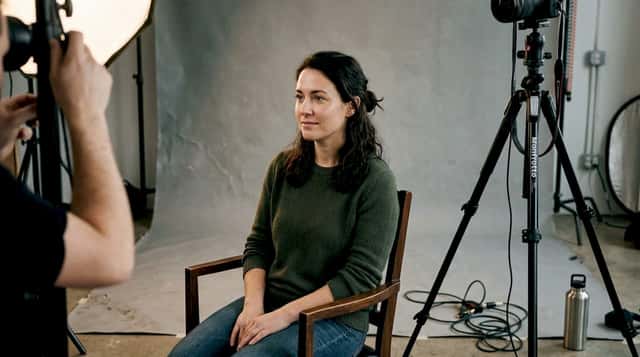
The neutral background is the most commonly chosen for corporate photo settings, and there is a very concrete reason behind this preference. Against a medium gray, off-white, or warm beige background, the subject occupies all visual attention. There’s no architecture, no text, no furniture competing for the viewer's gaze.
This has a huge practical advantage: the same session works for LinkedIn, the corporate website, business cards, press releases, and marketing campaigns. The image does not "expire" even if you change companies or positions, because the context is not inscribed in the background.
What distinguishes a vulgar neutral background from an artistic one is the lighting. A soft gradient that transitions from dark gray to light gray behind the subject creates depth without visual noise. The texture of the paper or fabric of the background, almost imperceptible, adds organic warmth. It is minimalism with intention, not a lack of decision.
3. Environmental Scenarios: the Office or Workspace as Context
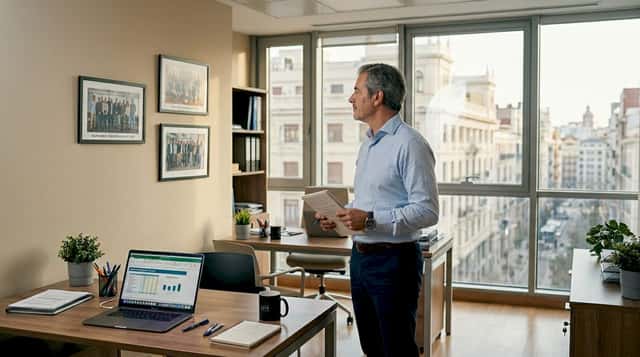
Portrait photos in the office have a quality that no studio can fully replicate: the authenticity of the real context. Seeing an architect in front of their plans or a lawyer in their office with bookshelves conveys competence in an immediate and credible way.
The most commonly used environmental scenarios include:
- Corporate lobby or reception. Ideal for portraits that communicate stability and institutional presence. The architecture does the work of conveying scale and seriousness.
- Meeting room with side natural light. A large window on one side creates soft, direct lighting that naturally shapes the face. The blurred background of the room adds context without distracting.
- Library or documentation archive. Communicates knowledge and experience. Works especially well for consultants, academics, or legal profiles.
- Workshop, laboratory, or production space. For manufacturing, industrial design, or technology companies, showing the productive environment reinforces technical credibility.
- Exterior spaces of the corporate building. A modern facade or a well-lit courtyard can serve as a photographic setting and as a signal of institutional identity.
The weak point of these scenarios is the longevity of the portrait: if the professional changes companies, the visual context becomes outdated. For this reason, they are often combined: a series with a neutral background for general use and an environmental series for specific company communication.
4. Brand Backgrounds: Integrating Visual Identity into the Scene

This is one of the least explored types of backgrounds for professional portraits, and when well executed, it produces very powerful results. It involves designing or selecting the background so that corporate colors, the blurred logo, or brand patterns subtly appear behind the subject.
A technology company with a deep blue visual identity can photograph its management team in front of a wall painted in that exact shade. The result is immediately recognizable as part of the brand's visual family. When a well-planned session reinforces visual consistency, the set of portraits functions as a system, not as standalone images.
Professional Tip: The logo should never appear sharp in the background of a portrait. Blurred or integrated as texture, yes. Readable and static, no. It competes with the face and fragments attention.
5. Examples of Scenarios for Team and Group Portraits
Group portraits have their own logic that goes beyond multiplying individual complexity. Visual cohesion is the goal, and the scenario is the main tool to achieve it.
- Corporate wall with neutral institutional background. A wall painted in the corporate color or a solid backdrop ensures uniformity even when team members wear a certain variety. Coherence comes from the background, not the clothing.
- Co-working space or open workroom. For companies with a collaborative culture, showing the actual space where the team works communicates horizontalism and openness. It requires greater lighting planning.
- Exterior of the building or corporate gardens. Natural light enhances spontaneity and warmth. It is an excellent option for sectors where an informal yet professional image matters.
- Studio with controlled lighting and neutral background. When the team is large and the session needs to be efficient, the studio with constant and repeatable light is the smartest choice. It allows photographing each person under exactly the same conditions, giving the final set a uniformity that no environmental setting can guarantee.
For group sessions, a minimum space of 15 by 15 feet with high ceilings is ideal for working comfortably and with quality. The lack of logistical planning is the number one cause of delays in these sessions, so assigning an internal coordinator to manage shifts and the order of entry is as important as choosing the setting.
6. Scenario comparison: advantages and limitations by type
The following table helps you make informed decisions based on the context and usage needs:
| Type of scenario | Versatility of use | Longevity | Ideal for | Main limitation |
|---|---|---|---|---|
| Neutral background (gray, white, beige) | Very high | 3 to 5 years | All sectors and platforms | Can seem generic without good lighting |
| Environmental (office, lobby) | Medium | 1 to 2 years | Specific corporate communication | Expires if the environment or company changes |
| Brand (colors and visual identity) | Medium | 2 to 3 years | Brand campaigns, corporate website | Requires redesign if visual identity changes |
| Decorative with personalized elements | Low or medium | Variable | Personal branding, creative profiles | Hard to replicate for large teams |
For LinkedIn, web, and press, the neutral background has a clear advantage due to its adaptability. For marketing campaigns or product launches, brand backgrounds create a greater impact. Ideas for business photos that work best in the long term often combine at least two types of scenarios in a single session.
7. How to choose corporate scenarios based on your profile and objective
The choice of scenario changes significantly depending on who you are and what you will use the portrait for. Here are my recommendations based on the situation:
- Executives and managers. A neutral background with quality lighting is the most solid option. Executives need longer sessions, between 20 and 30 minutes, to capture a genuine variety of expressions. The setting should not compete with the subject's presence.
- Creative teams and agencies. An environmental setting that showcases the workspace communicates culture and authenticity. Textured or colored backgrounds can work well if they align with the studio's visual identity.
- Startups and companies with a casual image. The exterior of a modern building, a coworking space, or even a carefully selected urban environment conveys dynamism without losing professionalism.
- Professionals in transition or image update. A neutral background is the safest bet. Detailed prior communication with the photographer allows for adapting the lighting and composition to the new professional moment without tying oneself to a context that is no longer relevant.
- Always consult with your photographer. This is not generic advice. The choice of setting directly affects technical planning: the lighting equipment, timings, possible angles. Arriving at the session with the setting already decided without consulting can seriously limit the creative options available.
To delve deeper into this decision, the corporate background criteria that Arnds analyzes in his blog are a very concrete starting point.
My perspective: the setting is where the portrait begins
I have photographed executives, teams, creatives, and entrepreneurs in all kinds of environments, and there's one thing I keep seeing too often: the setting is chosen in the last five minutes. You arrive at the session, look around, and pick something that seems "neutral enough." The result may be technically correct. But it lacks something. It lacks intention.
What I have learned is that the choice of setting is an extension of personal branding. When the setting and the subject are aligned, the photo doesn't look like a corporate photo. It looks like a statement. That difference is subtle when viewing the image but immense in the effect it has on the recipient.
The most common mistake I see is not choosing the wrong setting. It’s choosing it without asking what story it should tell. If you have that question answered before arriving at the studio, the session becomes much smoother and the result much more powerful.
You can see how we apply this approach in the artistic corporate photography we do at Arnds, where the setting always starts with a conversation, not with a catalog.
— Arnd
Artistic corporate portraits with Arnds in Palma de Mallorca
If you have made it this far, you already understand that a well-executed corporate portrait requires much more than a phone pointing at your face. It requires thoughtfully designed backgrounds, lighting that reinforces the message, and a photographer who knows how to make you feel comfortable in front of a camera.
At Arnds, we work with professionals and companies that want portraits that truly communicate. Whether in individual or group sessions, the process starts with a consultation where we define together the setting, style, and goal of the images. The artistic portraits in Palma we create are designed to last and to represent you authentically on any platform. If you have a team, our corporate headshot sessions for teams are specifically designed to ensure visual consistency with logistical efficiency. Contact us, and let's start that conversation.
FAQ
What background is best for an individual corporate portrait?
A neutral background in gray, white, or beige is the most versatile and enduring option for use across multiple platforms for three to five years. If the portrait has a specific brand use, an environmental or corporate visual identity setting can add additional value.
How much does a corporate portrait session cost?
The typical budget for individual portraits ranges from 250 to 600 USD, while team sessions usually cost between 150 and 400 USD per person. The price varies depending on the photographer, duration, and type of setting.
How to choose corporate settings for group sessions?
For groups, a spacious area with controlled lighting and a neutral background ensures the greatest visual consistency. Designating an internal coordinator and conducting pre-tests of the space significantly reduces delays during the session.
Can the same setting be reused when updating a corporate portrait?
Yes, as long as you document the lighting setup and position of the original setting. This allows for the precise replication of conditions in future sessions, maintaining visual consistency across the board.
When is it appropriate to use an environmental setting instead of a neutral background?
An environmental setting is ideal when the professional context is part of the message you want to convey, such as in technical, legal, or institutional sectors. Its limitation is its relevance: if you change companies or environments, the portrait may become outdated sooner than expected.