Print high-quality portraits and enhance your art
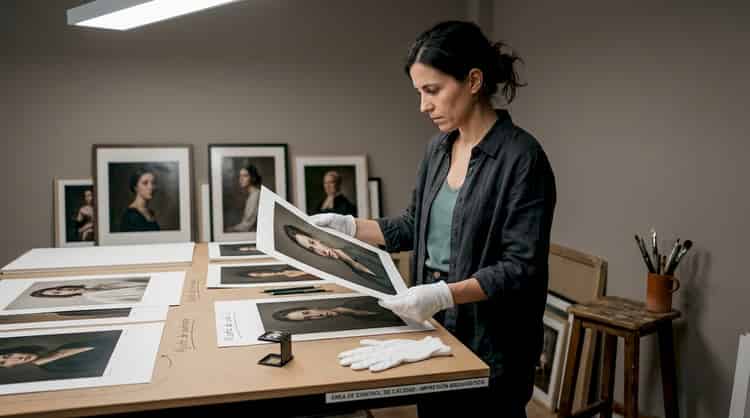
There is something that a screen will never fully tell you: skin has texture, eyes have depth, and an expression filled with emotion can last for generations if you know how to print it well. When you look at a portrait on a monitor, you see precisely arranged pixels. When you hold it printed in your hands, you see a story. Printing portraits in high quality reveals details, textures, and invisible volumes on digital screens, and that completely changes the artistic and emotional experience of those who view them.
Table of Contents
- The artistic and emotional value of a printed portrait
- Why does quality matter? Durability and authenticity
- Materials and techniques in Palma de Mallorca: canvas, inks, and fine art papers
- Tips for achieving the best printed portrait
- Why a printed portrait makes a real difference
- Bring your portraits to life in Palma de Mallorca
- Frequently asked questions
Key Points
| Point | Details |
|---|---|
| Authenticity and connection | High-quality printing allows for a unique experience of the essence and emotion of a portrait. |
| Guaranteed durability | Professional materials such as fine art and Giclée techniques preserve portraits for generations. |
| Emphasis on the tangible | A printed portrait transcends digital and creates a visual legacy with sentimental value. |
| Choose materials wisely | Canvas, fine art paper, and eco-solvent inks provide intense colors and greater longevity. |
The artistic and emotional value of a printed portrait
The difference between seeing and feeling a portrait begins the moment you print it. When I work with clients in Palma de Mallorca and I hand them a printed copy of their session, the reaction is usually the same: a brief silence, followed by something akin to astonishment. That does not happen in front of a screen.
High-quality printing allows subtle nuances, such as the soft glow at the corner of the lips or the microstructure of a hair illuminated by the afternoon sun, to emerge with a presence that monitors cannot faithfully reproduce. Screens emit light, but paper reflects it. And that physical difference between light emission and reflection changes the way your brain processes the image.
The physical prints create a tactile and emotional connection far superior to digital, especially when it comes to portraits that reflect someone's personality. It's not nostalgia, it's neurology: touch activates memories and emotions in a way that pure visual experience simply cannot reach.
There are several elements that make a printed portrait a complete artistic experience:
- Surface texture: Fine art paper absorbs ink differently than standard photographic paper, creating unique tonal depths that almost imitate painting.
- Tangible dynamic range: Shadows are softer and highlights less harsh than on a calibrated monitor.
- Perceived permanence: Holding something physical activates a feeling that this moment truly exists, outside the ephemeral flow of digital images.
- Spatial presence: A portrait hung on a wall does not need to be turned on to exist. It is there, always, silently speaking of the person who appears in it.
"A printed portrait is not just a photograph hanging on a wall. It is a statement that this person, this moment, this emotion deserves to be permanent."
Understanding the artistic connection in photography helps understand why the creative process does not end in the camera, but on paper. And the storytelling in portraits takes on a completely different meaning when that story can be touched with fingers.
Now that you know how print transforms the perception of a portrait, we will analyze the impact of quality on the durability and preservation of these works.
Why does quality matter? Durability and authenticity
Investing in quality is not an aesthetic whim. It's a decision about how long you want that portrait to remain true to itself. The color of cheap paper can turn yellow in just a few years. A low-quality print will lose contrast, detail, and presence long before its subjects wish it to.
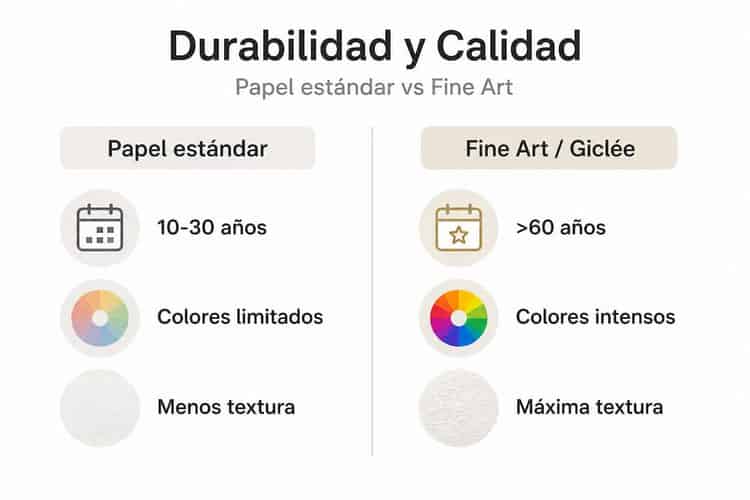
The most significant difference lies in the support material and the printing method. Here is a direct comparison:
| Feature | Standard paper | Fine art / Giclée paper |
|---|---|---|
| Estimated durability | 10 to 30 years | Over 200 years |
| Color reproduction | Limited | Exceptional, wide color gamut |
| Texture | Smooth, no relief | Variable, with artistic character |
| Ink absorption | Surface | Deep, with greater tonal gradation |
| Light resistance | Low without varnish | High with certified materials |
| Price | Economical | Medium to high investment |
The Giclée technique, which uses ultra-fine inkjet heads to deposit microdroplets of pigment on cotton papers or specialized substrates, allows for color fidelity that is simply unmatched in conventional printing methods. High-quality Giclée prints last over 200 years, preserving artistic portraits with an emotional authenticity that transcends generations.
For those looking to capture your essence in portraits, it makes perfect sense to ensure that this work, once printed, retains its power for decades. What is invested in a quality photo session deserves a support that is worthy.
Professional tip: When ordering your print, always ask about the paper weight in grams per square meter (g/m²) and the permanence certification of the inks. A cotton paper between 200 and 340 g/m² with certified pigment inks is the minimum base to guarantee real durability, not just appearance.
Exploring the technical advantages for artistic portraits helps appreciate that attention to detail at every stage of the process, from capture to print, defines the final result.
Materials and techniques in Palma de Mallorca: canvas, inks, and fine art papers
Palma de Mallorca is not only a privileged setting for photographing portraits. It also has printing services that often surprise those discovering them for the first time. The combination of Mediterranean light during the session and careful printing with top-quality materials results in outcomes that speak for themselves.
These are the main materials and techniques currently available on the island:
| Material | Weight / Specification | Finish | Recommended use |
|---|---|---|---|
| Polyester canvas | 320 to 390 g/m² | Matte or satin | Canvas portraits, large format |
| Fine art cotton paper | 200 to 340 g/m² | Matte with texture | Framed artistic portraits |
| Premium photographic paper | 200 to 300 g/m² | Glossy or pearl | Classic high-definition portraits |
| Barite paper | 300 to 350 g/m² | Satin with mineral base | Black and white portraits |
Services like Vinilos Palma use canvas from 320 to 390 g/m² with eco-solvent inks for portraits with high durability and vivid colors. Eco-solvent inks are especially valued because they combine chromatic intensity with water resistance, UV ray protection, and longevity, without compromising the natural look of the image.
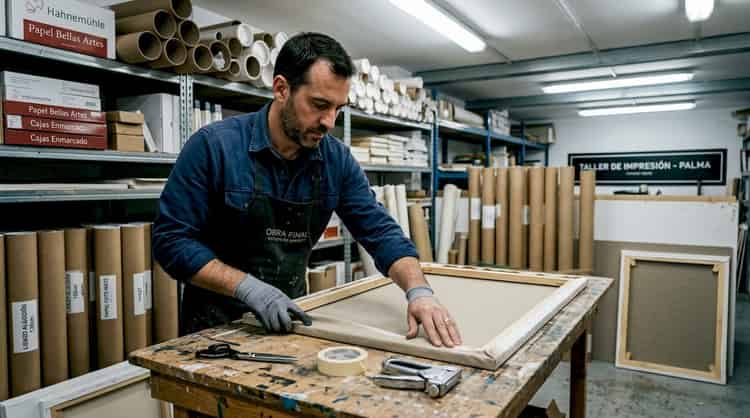
What distinguishes the best printing services in Palma is not just the machinery. It's the personalized advice. An experienced technician can recommend whether your portrait works better on a pronounced textured canvas or on high-contrast baryta paper, depending on the color palette, original lighting, and the space where it will be hung.
If you are looking for individual portraits in Mallorca, the ideal process combines an artistic photoshoot with the selection of the printing medium during the final consultation. This ensures consistency between the creative vision and the physical result.
Professional tip: For large format portraits (larger than 60 x 80 cm), stretched canvas on a frame is the most robust option. For medium formats intended for collecting or framing, fine art cotton paper adds more soul and detail. Talk to the person photographing you and with the lab before deciding, because the ideal format depends as much on the subject as on the space where the image will live.
Before choosing a photographer in Palma, it is worth understanding what printing options are offered or which labs they work with. The complete chain, from the camera to the wall, defines the final experience. And if you already know you want a professional portrait in Palma, asking about printing options from the first contact is a clear sign that you value the result as much as the process.
Tips for achieving the best printed portrait
Properly preparing a photograph for printing is a skill that makes the difference between a mediocre result and a piece that impresses. Here I share the steps that I consider fundamental:
Choose the image with technical and emotional criteria. A photograph can look beautiful on screen and fail in print if the resolution is not sufficient. Look for images with real sharpness at the main point of interest (usually the eyes in a portrait) and with at least 300 dpi in the final size you wish to print.
Check the color space of the file. For professional printing, the Adobe RGB or ProPhoto RGB color profile retains more tonal information than sRGB. If your photographer works in RAW and delivers high-quality files, this will already be resolved.
Avoid excessive editing before printing. Screens tend to make images look like they need more contrast or saturation than they actually require. A professional lab will make test color adjustments before printing, and an image with too much digital processing is difficult to correct.
Talk to your photographer about the destination of the image. Will it be in a hallway with natural light? In an office with cold artificial lighting? The lighting context where the portrait will live affects what type of finish and support to choose.
Request a small test print before the final format. A test in a reduced size allows you to verify that the colors and exposure behave as you expect on the chosen paper, without risking the full cost of a large piece.
Physical prints create a tactile and emotional connection that is superior to digital, and that connection is only achieved when the base file matches the support. That's why the preparation work is as relevant as the session itself.
Professional tip: Always save the original uncompressed file at maximum resolution. Deliver a retouched working copy to the lab, not the original. This allows you to repeat the printing in the future with any adjustments you desire, without losing quality.
For those who want to achieve authentic portraits, the printing process is the last link in a chain that starts with photographic intention and ends with an object that tells your story permanently.
Why a printed portrait makes a real difference
I want to be honest with you about something that is rarely said in photography articles: the proliferation of digital images has emotionally devalued photographs. Not because they are technically worse, but because they are excessively abundant. A gallery of a thousand images on your phone has less emotional impact than a single printed portrait hanging in the entrance of your home.
The physical permanence creates a type of intimacy that no screen can reproduce. When you hold a printed portrait in your hands, that image no longer competes with notifications, email, or endless scrolling. It is yours, completely, in that moment.
I have seen clients become unexpectedly emotional when they receive their printed portraits. It is not vanity; it is recognition. They see themselves in something tangible and well-made. That experience has a value that transcends any technical argument about resolution or color gamut.
Comments (0)
No comments yet. Be the first!