
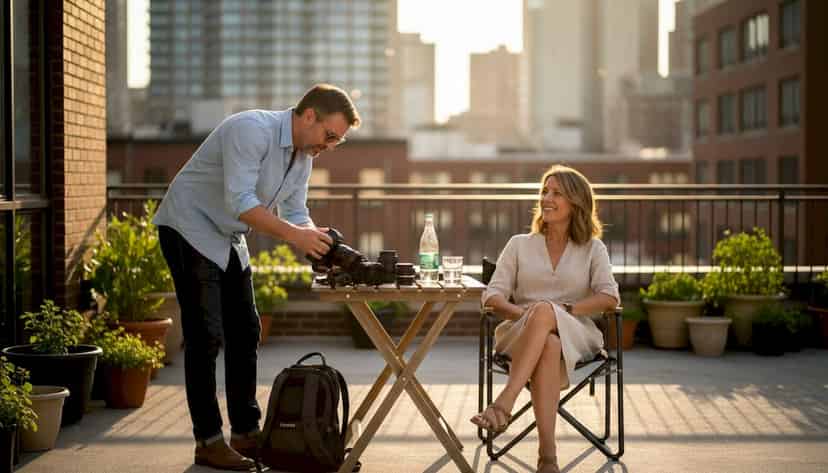
How to Tell Stories in Photos and Create Moving Portraits

There is a very specific moment that many of my clients describe similarly: they look at their portraits and feel that something is missing. The image is technically correct, the framing is good, the light is nice. But they do not recognize themselves. They do not feel reflected. That feeling of emptiness is, in fact, the absence of narrative. A portrait without a story is just a visual record. This guide shows you step by step how to transform your photographs into images that communicate who you are, what you feel, and what you want the world to see in you. You will learn the key elements, the necessary planning, the most common mistakes, and how symbolism can turn a portrait into something truly yours.
Table of contents
- Why is it important to tell a story in a portrait?
- Essential elements and prior planning
- Step by step: composing narrative photos
- Common mistakes, adjustments, and final checks
- Personal narratives and the power of self-portraiture
- Our perspective: what really matters behind each image
- Ready to create your own narrative portrait?
- Frequently asked questions
Key Points
| Point | Details |
|---|---|
| Plan the story | Before shooting, define the emotion and message you want to convey in your portrait. |
| Use composition | The rule of thirds, leading lines, and color help direct the gaze and generate visual storytelling. |
| Create emotional connection | The real success of a narrative photo is measured by how it resonates with the viewer, not by the technique. |
| Experiment with self-portraits | Use symbolisms and self-portraits to explore personal stories and boost creativity. |
Why is it important to tell a story in a portrait?
There is a fundamental difference between a descriptive image and a narrative image. The former answers the question "What is here?". The latter answers "What is happening, what does it feel like, what does it mean?". That difference, seemingly subtle, changes everything.
A narrative photo doesn’t need words to explain itself. It generates a reaction before the viewer can consciously analyze it. That’s what we seek when we talk about authentic and memorable portraits: images that remain in memory because they touch on something real.
The visual storytelling uses composition, timing, perspective, color, and texture to build emotional narrative. Each of these elements guides the viewer's gaze and tells them, without words, where to look and what to feel. The rule of thirds, leading lines, tonal contrast: everything communicates.
A narrative image achieves three things that a conventional photo rarely does:
- Motivates personal interpretation: the viewer completes the story with their own experience, creating a unique connection.
- Creates memorability and connection: emotionally charged images are remembered much more than purely descriptive ones.
- Guides the viewer's visual reading: the composition acts as a score that indicates the rhythm and direction of the gaze.
The success in narrative photography is not measured with quantitative metrics, but by the emotional connection and resonance it generates in those who observe it.
"A memorable portrait is not evaluated by its sharpness or perfect exposure. It is evaluated by the emotion it evokes in the one who looks at it."
Now that you’ve seen the importance of storytelling in a portrait, let’s explore what you need before you start.
Essential elements and prior planning
Before picking up the camera, you need clarity. Planning doesn’t kill spontaneity; on the contrary, it enables it. When you know where you are going, you can afford to improvise along the way.
The key elements of artistic portraits go beyond technical equipment. They include the emotional concept you want to convey, the environment that reinforces that message, and the accessories that add layers of meaning.

| Tool | Narrative Function |
|---|---|
| Camera (DSLR, mirrorless, or smartphone) | Capture the moment with technical control |
| Type of light (natural, artificial, mixed) | Define the emotional state of the image |
| Background (neutral, urban, natural) | Contextualize and expand meaning |
| Personal accessories | Add symbolism and personality |
| Editing software | Refine tone and visual coherence |
The narrative planning includes identifying the theme, researching visual references, constructing the concept, and defining the production before shooting. The role of the photographer in this process is to guide that construction with sensitivity and artistic criteria.
The preliminary process, summarized in four steps:
- Define the central theme or emotion: what do you want the viewer of this image to feel?
- Research visual references: look for photographers, paintings, or movies that inspire you.
- Visualize the story: imagine the final image before framing.
- Plan the production: location, time of day, wardrobe, props, and equipment.
Professional tip: Before each session, write down three words that describe the emotion or message you want to convey on a piece of paper. Those words will be your compass throughout the session and will help you make quick decisions about composition, light, and posing.
With good planning and materials ready, we move on to the specific creative process.
Step by step: composing narrative photos
The execution is where planning turns into image. Here, the order matters, because each decision you make builds or destroys the story.
- Choose your subject with intention: think not only about who they are but what aspect of their personality you want to reveal.
- Define the environment as part of the narrative: the background is not decoration; it is context. A peeling wall conveys something different than a blooming garden.
- Apply the rule of thirds and leading lines: place the subject at points of interest and use elements of the environment to direct the gaze.
- Work with color and texture: warm tones evoke closeness; cool tones evoke distance or introspection. Texture adds tactile depth to the image.
- Look for the precise timing: the expression of a fraction of a second can transform a correct photo into a powerful image.
- Build a visual sequence: instead of looking for a single perfect photo, think of a three-act structure that takes the viewer from the introduction to the climax.
For creative outdoor portraits in Palma de Mallorca, the Mediterranean light offers extraordinary possibilities. Taking advantage of it requires understanding how it changes throughout the day and how it affects the emotional state of the image.
| Narrative sequence | Single photo |
|---|---|
| Creates progression and visual tension | Captures an isolated moment |
| Allows for introduction, development, and closure | Depends on a perfect instant |
| More flexible for the viewer | Greater immediate impact |
| Ideal for complex stories | Ideal for direct emotions |
The visual storytelling in three photos (protagonist, antagonist and environment, or wide, medium and tight shot) creates tension and progression naturally and effectively.
Professional tip: Play with selective focus to isolate the subject from the environment and enhance the narrative impact. The use of light in combination with a wide aperture can immerse the background in an extremely soft, almost artificial blur, concentrating all emotional attention on the face.
With clear steps, it is essential to avoid common mistakes and learn the nuances of post-analysis.
Common mistakes, adjustments, and final verification
Most portraits that do not work emotionally share the same flaws. Identifying them is the first step to correcting them.
- Obsession with technique: when the photographer is too focused on exposure or focus, they lose sight of the emotion of the moment. Technique should be invisible.
- Neglecting the emotional message: shooting without a clear idea of what you want to communicate produces empty images, even if they are visually impeccable.
- Excessive artificial poses: stiff or overly studied poses eliminate authenticity. The subject should feel comfortable, not acting.
- Ignoring the background context: a cluttered or incoherent background with the message immediately breaks the narrative.
The authentic author photography is distinguished precisely by prioritizing emotional coherence over technical perfection.
There is also an important distinction between narrative photography and documentary photography. The narrative vs. documentary marks a difference in intention: narrative emphasizes creative structure and interpretation; documentary prioritizes honest testimony of reality. Neither is superior; they are distinct tools for different purposes.
To verify if your image works emotionally, try these strategies:
- Show the photo to someone who was not present and ask them to describe what they feel, not what they see.
- Analyze if the subject's expression and the composition tell the same story or contradict each other.
- Compare the image with the three words you wrote before the session. Do they evoke them?
"The success of a portrait is not measured by its sharpness or exposure, but by the emotional connection it generates in the viewer."
With the mistakes under control, you can explore more personal or therapeutic styles in photographic storytelling.
Personal narratives and the power of self-portraiture
The self-portrait is perhaps the most honest form of narrative photography. There are no intermediaries between the artist and the story. It is you who decides what to show, how to show it, and what to hide.
Symbolism is the most powerful tool in this territory. An everyday object, placed with intention, can transform a simple image into a profound statement about identity, loss, hope, or transformation. The types of artistic portraits that incorporate personal symbolism are the ones that last the longest in the viewer's memory.
Some symbolic resources you can explore:
- Personal objects with history: a letter, a musical instrument, a treasured garment. Each object carries layers of meaning that the camera can capture.
- Games of light and shadow: one half of the face illuminated and the other in shadow can immediately and powerfully represent duality, internal conflict, or mystery.
- Textures and creative overlays: overlaying an organic texture (wood, water, fabric) onto the portrait adds an almost tactile dimension that enriches the visual narrative.
Surrealist self-portraits allow capturing the internal narrative and emotional healing through symbolism, turning photography into a therapeutic as well as an artistic process.
Professional tip: Use self-portraiture as a self-exploration exercise before working with other subjects. Understanding what you find difficult to show about yourself will make you more empathetic and effective as a portrait photographer.
After experimenting with narrative self-portraits, we move on to our professional opinion about what really works.
Our perspective: what really matters behind every image
After years of creating portraits in Palma de Mallorca, I have come to a conclusion that goes against what many photography courses teach: technique is the starting point, not the destination.
I constantly see photographers who invest in more expensive equipment, study light for months, and master editing software, but still produce images that don’t connect with anyone. The problem is not technical. It’s emotional.
The portraits that truly matter, the ones people frame and keep for decades, stem from a moment of genuine connection between the photographer and the subject. That connection cannot be faked or manufactured in post-production.
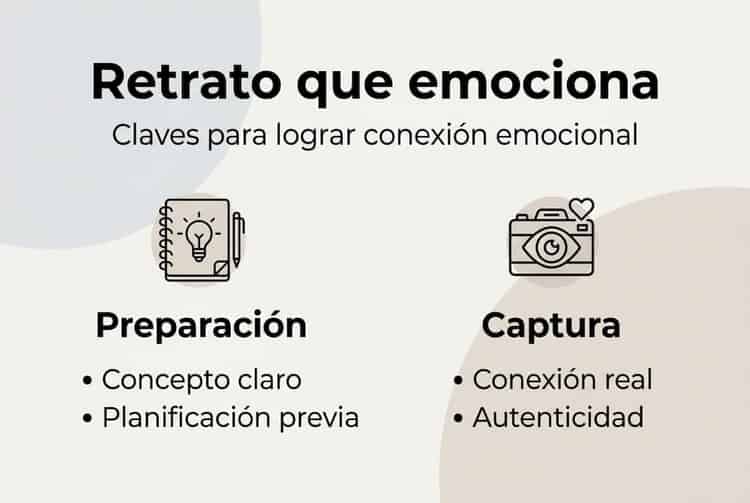
The impact of emotional authenticity in a portrait is what separates an image that is forgotten from one that remains. There are no metrics to measure it. There is no exact formula. But it is felt immediately when it is present, and its absence is equally evident.
My most honest advice: before worrying about equipment or technique, ask yourself what you want the person looking at this image to feel in ten years.
Ready to create your own narrative portrait?
More Posts
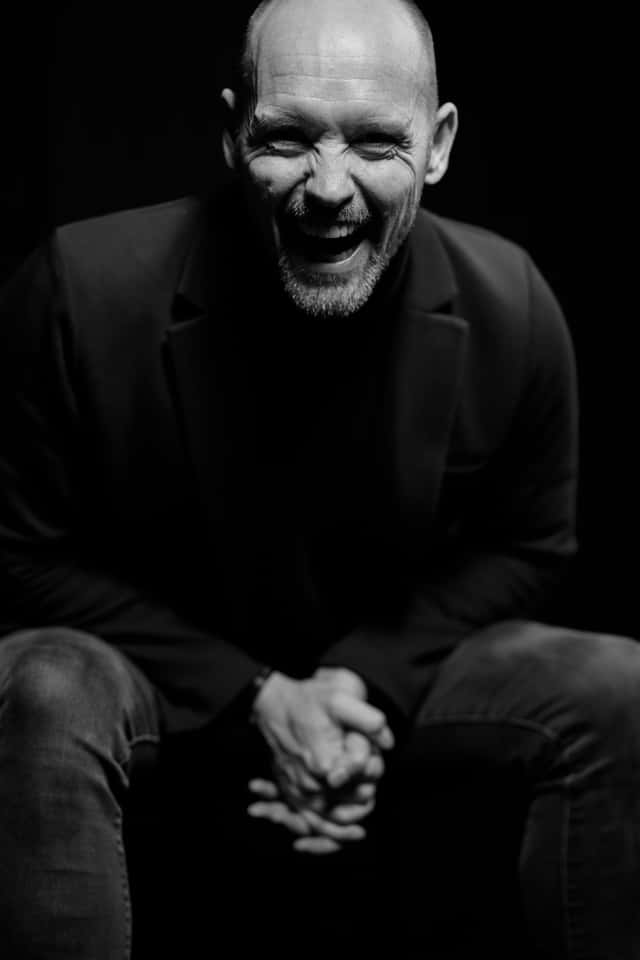
40 Portraits, €8,000, and a Night That Stays
At OMR's birthday in Hamburg I shot 40 portraits — for free. The donations raised for Fundació Predator: over €8,000. The story of one night.
Visual Quality: The Key to Authentic Artistic Portraits
Discover why visual quality is essential in artistic portraits: techniques, perception, and how to connect emotion and authenticity in every image.